
Kisspeptin
From $31.50to $262.50
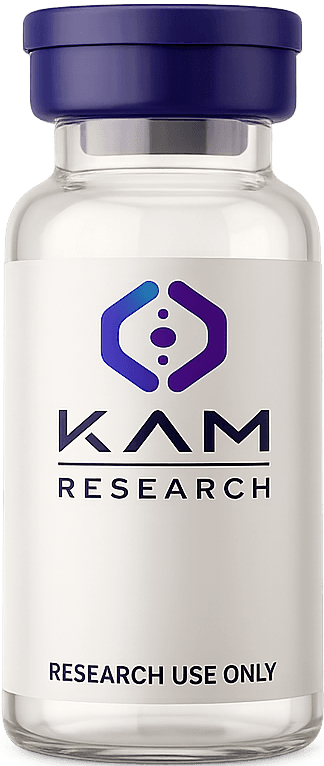
Kisspeptin-10 peptide (human), lyophilized reference standard for in vitro laboratory research.
Volume Tier Pricing · Mix & Match
Combine eligible single vials across catalog items to unlock volume rates.
Add 1 more eligible vial to unlock 12.5% total savings.
Price
$31.50
✓ You save $3.50 (10% total savings vs regular price)
Quantity
In Stock · 100 Units Available
This strength’s Certificate of Analysis isn’t published yet — add to cart will be enabled once the lab report is available.
- Free FedEx 2-Day shipping over $200. Dispatched the same day when ordered before 4 p.m. PT Monday–Friday, or 11 a.m. PT Saturday. Los Angeles and the surrounding area usually arrive the next business day. Shipping details
- Third-party HPLC tested. Every lot ships with a batch-linked certificate of analysis naming the laboratory, the method and the measured result. Browse certificates
- Questions about this material? Message us on WhatsApp +1 (747) 204 9968 or email support@kamresearch.com. Monday–Friday, 8 a.m.–5 p.m. PST.
Certificate of Analysis & Specifications
Documentation will be published once this lot completes third-party analytical release.
Released COA Library
Published Certificates of Analysis for Kisspeptin. All released analytical records are preserved here. Pending and in-testing lots are reachable only through the QR printed on the vial.
No released certificate for this material yet
Reports appear here once a batch has completed third-party analytical release.
Research Data
Chemical & Structural Identifiers
- Chemical Name (IUPAC)
- L-tyrosyl-L-asparaginyl-L-tryptophyl-L-asparaginyl-L-seryl-L-phenylalanylglycyl-L-leucyl-L-arginyl-L-phenylalaninamide
- CAS Registry Number
- 374675-21-5 (Kisspeptin-10 monomer)
- PubChem CID
- 9832791
- Molecular Formula
- C63H83N17O14
- Molecular Weight
- 1301.63 Da (1302.44 g/mol average)
- Sequence
- H-Tyr-Asn-Trp-Asn-Ser-Phe-Gly-Leu-Arg-Phe-NH2 (Single-letter: YNWNSFGLRF-NH2)
- SMILES
- CC(C)C[C@@H](C(=O)N[C@@H](CCCNC(=N)N)C(=O)N[C@@H](CC1=CC=CC=C1)C(=O)N)NC(=O)CNC(=O)[C@H](CC2=CC=CC=C2)NC(=O)[C@H](CO)NC(=O)[C@H](CC(=O)N)NC(=O)[C@H](CC3=CNC4=CC=CC=C43)NC(=O)[C@H](CC(=O)N)NC(=O)[C@H](CC5=CC=C(C=C5)O)N
- InChIKey
- KKLNQVYXQYYYPA-XVBWMSOYSA-N
- Salt / Counter-Ion
- Supplied as a high-purity lyophilized acetate (CH3COO-) or trifluoroacetate (CF3COO-) salt.
- Synonyms
- Kisspeptin-10, KP-10, Metastin (45-54), KISS-1 (112-121), Kp10 Decapeptide
Analytical & COA Specifications
- Analytical Purity (RP-HPLC)
- ≥ 98.0% area normalization under UV detection at λ = 214 nm and 280 nm (tyrosine and tryptophan chromophore detection).
- Identity Confirmation (RP-HPLC RT + UV vs. reference)
- Main peak retention time and UV spectrum conform to the reference standard.
- Physical Characterization
- Dense, white to off-white lyophilized solid cake/powder.
Handling & Stability
Storage. Store dry solid desiccated at -20°C to -80°C, sealed under an inert gas matrix and protected from ambient light.
Solubility. Soluble in sterile laboratory-grade deionized water (≥ 10 mg/mL), sterile Phosphate-Buffered Saline (PBS, pH 7.4, ≥ 5 mg/mL), or dilute sterile 0.1% acetic acid for stock stabilization in in vitro assay applications.
- Photostability & Handling Parameters: Contains aromatic residues (Tyr1, Trp3, Phe6, Phe10) that exhibit UV sensitivity; prepare concentrated stock solutions under amber light conditions, avoid high-shear vortexing, and aliquot into single-use fractions at -20°C to eliminate degradation from repeated freeze-thaw cycles.
Mechanism & Literature
Endogenous RF-amide neurohormone decapeptide serving as the minimum active pharmacophore of the KISS1 gene products. Functions as a full, high-affinity agonist at the G-protein coupled Kisspeptin Receptor (KISS1R / GPR54 / AXOR12), exhibiting nanomolar affinity (Ki ≈ 1.5--4.5 nM).
Cellular Pathways Investigated: Extensively documented in in vitro hypothalamic cell models (e.g., GT1-7 GnRH neuronal cell lines) and receptor-transfected cultures (CHO-K1/HEK293 expressing GPR54) to evaluate Gαq/11 signal transduction, Phospholipase C (PLC) activation, inositol 1,4,5-trisphosphate (IP3) and diacylglycerol (DAG) turnover, transient intracellular calcium mobilization ([Ca2+]i), and downstream phosphorylation of Extracellular Signal-Regulated Kinase 1/2 (pERK1/2) that triggers gonadotropin-releasing hormone (GnRH) gene transcription.
References (3)
- Kotani, M., et al. (2001). The metastasis suppressor gene KISS-1 encodes kisspeptins, the natural ligands of the orphan G protein-coupled receptor GPR54. Journal of Biological Chemistry, 276(37), 34631–34636.
- Seminara, S. B., et al. (2003). The GPR54 gene as a regulator of puberty and hypothalamic signaling in cellular and animal models. New England Journal of Medicine, 349(17), 1614–1627.
- Roseweir, A. K., et al. (2009). Discovery of potent kisspeptin antagonists delineate the role of KISS1R in gonadotropin release in vitro. Journal of Neuroscience, 29(12), 3920–3929.
Technical Laboratory FAQs
What structural element is essential for Kisspeptin-10 biological activity in vitro?
The C-terminal amidation (Phe10-NH2) and conserved C-terminal RF-amide motif (Arg9-Phe10-NH2) are critical for binding into the hydrophobic pocket of the KISS1R (GPR54) receptor; deamidation to free carboxyl forms drastically impairs receptor affinity in cell assays.
How does Kisspeptin-10 compare functionally to full-length Kisspeptin-54 in receptor binding assays?
Kisspeptin-10 represents the truncated C-terminal 10-amino-acid domain of Kisspeptin-54 and demonstrates equivalent binding affinity (Kd) and functional potency (EC50) in stimulating IP3 turnover and intracellular calcium influx in GPR54-expressing cell lines.
What solvent conditions are recommended for preparing in vitro Kisspeptin-10 working stocks?
Sterile deionized water or sterile PBS (pH 7.4) is standard for baseline biological assays. For long-term stock stabilization against asparagine deamidation (Asn2, Asn4), a weakly acidic buffer (such as sterile 0.1% acetic acid) provides maximum solution integrity prior to media dilution.
For Research Use Only. Not for human or animal administration. Not intended to diagnose, treat, cure, or prevent any disease. Sold for laboratory research purposes only.