
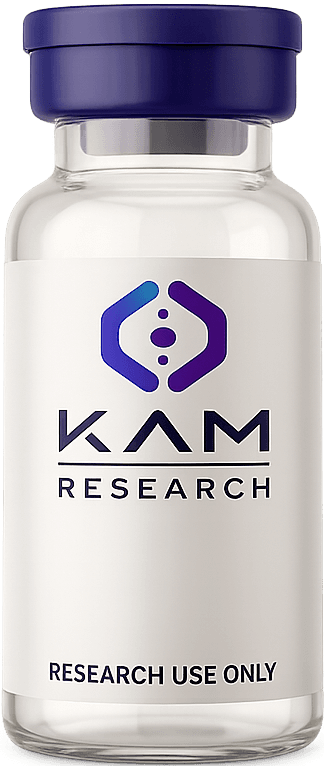
Tesamorelin
From $57.00to $570.00
For laboratory research use only. Not for human or animal use, consumption, diagnosis, treatment, or disease prevention.
This item is available only through approved account access.
Product Specifications
- Lot Number
- KRSTES-10-260824-01
- Purity
- —
- Storage Temp
- 36°F to 46°F
- Batch Status
- Pending Lab
For Research Use Only. Not for human or animal administration. Not intended to diagnose, treat, cure, or prevent any disease. Sold for laboratory research purposes only.
Documentation
Certificates of Analysis are supplied with each product lot where applicable.
All products currently listed on this site are for research purposes only.
COA Library — 10mg
Published Certificates of Analysis for Tesamorelin · 10mg. New deliveries are added as their batches are released.
No released COA for this strength yet
Reports appear here once a batch for this strength has been released.
Research Data
Chemical & Structural Identifiers
- Chemical Name (IUPAC)
- (3E)-hex-3-enoyl-[Tyr1]-human growth hormone-releasing factor(1--44) amide (N-[(3E)-hex-3-enoyl]-[L-tyrosyl-L-alanyl-L-α-aspartyl-L-alanyl-L-isoleucyl-L-phenylalanyl-L-threonyl-L-asparaginyl-L-seryl-L-tyrosyl-L-arginyl-L-lysyl-L-valyl-L-leucyl-glycyl-L-glutaminyl-L-leucyl-L-seryl-L-alanyl-L-arginyl-L-lysyl-L-leucyl-L-leucyl-L-glutaminyl-L-α-aspartyl-L-isoleucyl-L-methionyl-L-seryl-L-arginyl-L-glutaminyl-L-glutaminyl-glycyl-L-α-glutamyl-L-seryl-L-asparaginyl-L-glutaminyl-L-α-glutamyl-L-arginyl-glycyl-L-alanyl-L-arginyl-L-alanyl-L-arginyl-L-leucinamide])
- CAS Registry Number
- 218949-48-5 (Free base); 901758-09-6 (Acetate salt)
- PubChem CID
- 16137828
- Molecular Formula
- C221H366N72O67S
- Molecular Weight
- 5132.70 Da (5135.86 g/mol average)
- Sequence
- [trans-3-hexenoyl]-YADAIFTNSYRKVLGQLSARKLLQDIMSRQQGESNQERGARARL-NH2
- InChIKey
- UGKJZROHGBPBKJ-UHFFFAOYSA-N
- Salt / Counter-Ion
- Supplied as a high-purity lyophilized acetate (CH3COO-) or trifluoroacetate (CF3COO-) salt.
- Synonyms
- Tesamorelin, TH9507, trans-3-Hexenoyl-GHRH (1-44) amide, Tesamorelin Acetate, Hexenoyl Growth Hormone-Releasing Factor.
Analytical & COA Specifications
- Analytical Purity (RP-HPLC)
- ≥ 98.5% (typically ≥ 99.0%) by area normalization under UV detection at λ = 214 nm and 280 nm.
- Identity Confirmation (ESI-MS / MALDI-TOF)
- Theoretical mass [M+H]+ = 5136.9 Da; observed mass matches expected multivalent charge envelopes ([M+4H]4+ = 1284.9 Da, [M+5H]5+ = 1028.2 Da, [M+6H]6+ = 857.0 Da) within ± 0.8 Da.
- Residual Moisture (Karl Fischer Titration)
- ≤ 3.0% water content.
- Endotoxin Screening (LAL Assay)
- < 1.0 EU/mg (Limulus Amebocyte Lysate per USP <85>).
- Sterility Validation
- USP <71> compliant (no observed microbial proliferation in fluid thioglycollate or soybean-casein digest broths).
- Physical Characterization
- Dense, white to off-white lyophilized solid cake/powder.
Handling & Stability
Storage. Store dry solid desiccated at -20°C to -80°C, protected from atmospheric moisture and direct light.
Solubility. Soluble in sterile laboratory-grade deionized water (≥ 10 mg/mL), sterile Phosphate-Buffered Saline (PBS, pH 7.4, ≥ 5 mg/mL), or dilute sterile 0.1% acetic acid for stock stabilization in in vitro assay applications.
- Handling & Methionine Oxidation Controls: Contains an internal methionine residue (Met27) susceptible to sulfoxide oxidation in aerated aqueous environments; prepare stock solutions using degassed neutral buffers (pH 7.0--7.4), avoid vigorous high-shear vortexing, and store single-use aliquots at -20°C to eliminate degradation from repeated freeze-thaw cycles.
Mechanism & Literature
Synthetic 44-amino-acid peptide analog of human Growth Hormone-Releasing Hormone (GHRH1--44). Functions as a potent, full agonist at the G-protein coupled Growth Hormone-Releasing Hormone Receptor (GHRHR).
Structural Engineering Rationale: Modified with a hydrophobic trans-3-hexenoyl group attached to the N-terminal tyrosine residue (Tyr1). This terminal acyl modification protects the peptide against rapid enzymatic degradation by dipeptidyl peptidase IV (DPP-4 / CD26) cleavage, significantly prolonging receptor engagement and biological half-life relative to unmodified native GHRH in vitro.
Cellular Pathways Investigated: Evaluated across in vitro pituitary somatotroph models, primary hepatocytes, and adipocyte cultures:
References (3)
- Ferdinandi, E. S., et al. (2007). Pharmacokinetics and metabolism of the GHRH analogue tesamorelin in vitro and preclinical models. Journal of Clinical Endocrinology & Metabolism, 92(8), 3020–3028.
- Falutz, J., et al. (2007). Metabolic effects of a growth hormone-releasing factor analogue, tesamorelin, in cell and translational models. New England Journal of Medicine, 357(17), 1703–1713.
- Clemmons, D. R., et al. (2014). Mechanisms of action of tesamorelin on hepatic lipid metabolism and growth hormone secretagogue signaling in vitro. Growth Hormone & IGF Research, 24(6), 213–222.
Technical Laboratory FAQs
What structural modification protects Tesamorelin from DPP-4 cleavage in vitro?
Tesamorelin features a trans-3-hexenoyl fatty acyl moiety attached to the N-terminal amino acid (Tyr1), providing steric protection that prevents dipeptidyl peptidase IV (DPP-4) from cleaving the active N-terminal Tyr1-Ala2 bond in cell culture media.
How does Tesamorelin activate somatotroph signaling cascades in cell culture?
Tesamorelin selectively binds the GHRH receptor, coupling to the Gαs protein to stimulate adenylyl cyclase, elevating intracellular cyclic AMP (cAMP) and activating PKA-dependent CREB phosphorylation cascades in vitro.
What solvent conditions are recommended for preparing in vitro Tesamorelin working solutions?
Sterile deionized water or sterile PBS (pH 7.4) dissolves the peptide at concentrations ≥ 5 mg/mL. Preparing stocks with degassed aqueous buffers protects the internal Met27 thioether from ambient oxidation during extended assay protocols.
For Research Use Only. Not for human or animal administration. Not intended to diagnose, treat, cure, or prevent any disease. Sold for laboratory research purposes only.