Quantity
Price
$40.00
100 available
This strength’s Certificate of Analysis isn’t published yet — add to cart will be enabled once the lab report is available.
NAD+
From $40.00to $405.00
For laboratory research use only. Not for human or animal use, consumption, diagnosis, treatment, or disease prevention.
This item is available only through approved account access.
Product Specifications
- Lot Number
- —
- Purity
- —
- Storage Temp
- 36°F to 46°F
For Research Use Only. Not for human or animal administration. Not intended to diagnose, treat, cure, or prevent any disease. Sold for laboratory research purposes only.
Documentation
Certificates of Analysis are supplied with each product lot where applicable.
Certificate of Analysis (COA)
Documentation will be available once product lots are received and tested.
All products currently listed on this site are for research purposes only.
COA Library — 500mg
Published Certificates of Analysis for NAD+ · 500mg. New deliveries are added as their batches are released.
No released COA for this strength yet
Reports appear here once a batch for this strength has been released.
Research Data
Chemical & Structural Identifiers
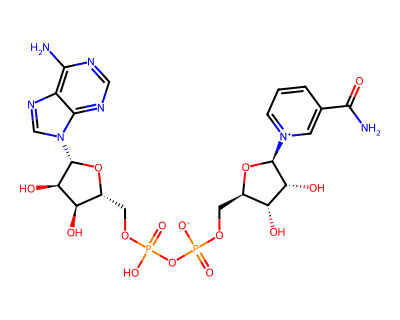
- Chemical Name (IUPAC)
- Pyridine-adenine dinucleotide consisting of a nicotinamide mononucleotide (NMN) moiety connected to an adenosine monophosphate (AMP) core via a high-energy phosphoanhydride (pyrophosphate) linkage.
- CAS Registry Number
- 53-84-9 (Free zwitterion / inner salt); 20111-18-6 (Monosodium salt)
- PubChem CID
- 5892
- Molecular Formula
- C21H27N7O14P2
- Molecular Weight
- 663.11 Da (663.43 g/mol average; monosodium salt: 685.41 g/mol)
- SMILES
- C1=CC(=C[N+](=C1)[C@H]2[C@@H]([C@@H]([C@H](O2)COP(=O)([O-])OP(=O)(O)OC[C@@H]3[C@H]([C@H]([C@@H](O3)N4C=NC5=C4N=CN=C5N)O)O)O)O)C(=O)N
- InChIKey
- BAWFJGJZGIEFAR-NNYOXOHSSA-N
- Salt / Counter-Ion
- Supplied as a high-purity crystalline free acid, zwitterionic inner salt, or lyophilized sodium (Na+) salt solid.
- Synonyms
- NAD+, NAD, β-NAD+, Coenzyme I, Nadide, Diphosphopyridine nucleotide (DPN), Oxidized DPN.
Analytical & COA Specifications
- Analytical Purity (RP-HPLC / Anion-Exchange HPLC)
- ≥ 98.5% by area normalization under UV detection at λ = 260 nm (adenine and pyridinium nucleotide absorption maximum).
- Identity Confirmation (ESI-MS / 1H-NMR)
- Theoretical mass [M+H]+ = 664.1 Da (positive mode) or [M-H]- = 662.1 Da (negative ionization mode); observed mass matches theoretical ionization envelope within ± 0.5 Da.
- Residual Moisture (Karl Fischer Titration)
- ≤ 3.5% water content.
- Endotoxin Screening (LAL Assay)
- < 1.0 EU/mg (Limulus Amebocyte Lysate per USP <85>).
- Sterility Validation
- USP <71> compliant (no observed microbial proliferation in liquid culture broths).
- Physical Characterization
- Dense, white to off-white or pale yellowish lyophilized crystalline powder.
Handling & Stability
Storage. Store dry solid desiccated at -20°C to -80°C, protected from atmospheric moisture and direct light (highly hygroscopic).
Solubility. Freely soluble in sterile laboratory-grade deionized water (≥ 50 mg/mL) and sterile Phosphate-Buffered Saline (PBS, pH 7.2–7.4, ≥ 30 mg/mL) for in vitro assay application.
- Hydrolytic Stability & pH Control: The quaternary N-glycosidic bond linking the nicotinamide ring to the ribose core is susceptible to base-catalyzed cleavage into free nicotinamide and ADP-ribose at alkaline pH > 8.0; prepare stock solutions in neutral to slightly acidic aqueous buffers (pH 6.0--7.2), avoid prolonged thermal exposure, and store single-use aliquots at -80°C to eliminate degradation from repeated freeze-thaw cycles.
Mechanism & Literature
Primary Biochemical Function & Classification: Central metabolic pyridine nucleotide coenzyme that functions both as a reversible electron carrier in cellular redox biochemistry (NAD+/NADH couple) and as an obligate, rate-limiting co-substrate for non-redox NAD+-consuming signaling enzymes.
Cellular Pathways Investigated: Evaluated across diverse in vitro cellular systems (including primary cortical neurons, cardiomyocytes, and skeletal muscle lines):
References (3)
- Imai, S., & Guarente, L. (2014). NAD+ and sirtuins in aging and disease. Trends in Cell Biology, 24(8), 464–471.
- Verdin, E. (2015). NAD+ in aging, metabolism, and neurodegeneration. Science, 350(6265), 1208–1213.
- Cambronne, X. A., et al. (2016). Biosensor reveals multiple sources for mitochondrial NAD+. Science, 352(6292), 1474–1477.
Technical Laboratory FAQs
How does the biochemical role of NAD+ in redox reactions differ from its function as a signaling co-substrate?
In redox metabolism (glycolysis, TCA cycle), NAD+ undergoes reversible two-electron reduction to NADH without net consumption of the dinucleotide molecule. In regulatory signaling (Sirtuins, PARPs, CD38), NAD+ is irreversibly consumed, cleaving the N-glycosidic linkage to release free nicotinamide and ADP-ribosyl derivatives.
Why is maintaining a neutral-to-slightly-acidic pH critical when handling NAD+ solutions?
The positively charged nicotinamide ring destabilizes the N-glycosidic bond under alkaline conditions (pH > 8.0), resulting in rapid non-enzymatic hydrolysis to ADP-ribose and nicotinamide, which can compromise analytical measurements and cell assay integrity.
What solvent conditions are recommended for preparing in vitro NAD+ stock solutions?
Sterile deoxygenated deionized water or sterile neutral PBS (pH 7.2–7.4) provides rapid dissolution at concentrations exceeding 30 mg/mL, establishing a stable working standard for enzymatic and cell-based metabolic assays.
For Research Use Only. Not for human or animal administration. Not intended to diagnose, treat, cure, or prevent any disease. Sold for laboratory research purposes only.